The Ancestral Wound Shaping Your Reality — Inherited, Not Chosen
The Ancestral Wound Shaping Your Reality - Inherited, Not Chosen.
When the NLP Communications Model Meets Inherited Trauma
By Fiona Ellis | Chapters 2 + 3 companion — You Can't Get There From Here
📖 From the Book
Adapted from Chapter 3: When Did You Last Laugh, Dance, Sing?
You Can’t Get There From Here — Healing the Inheritance You Didn’t Ask For
Order your copy →Do you ever have those moments where your body reacts before your mind has a chance to understand why?
I’ll be honest with you. There are certain people that my body will instinctively flinch in fear away from when I see them. And it pisses me off. Because many of them, once I get to know them, are kind, sweet people. But something in my filters — something I didn’t install and didn’t agree to — has labelled them as threat. So my body panics first. And then I have to sort out the truth from my unconscious reactions.
At least I know it’s happening. After twenty years of working with the NLP Communications Model, I can feel the flinch, recognise it as a filter, get curious, and choose a different response. I override the instinct with behaviour that is more rational, more compassionate. I seek to understand. And I usually form great connections with the people my nervous system tried to reject.
Most people don’t do that.
Most people feel the flinch and follow it. They don’t question the filter. They see the colour, the clothing, the label and don’t get curious. They just react — with judgement, avoidance, rejection — instinctive reactionary behaviour their unconscious filters produced.
And then they blame themselves for the reaction. Or worse — they blame the other person.
“They triggered me” is the catch cry of the self help industry — but what exactly did they trigger?
If someone bumps you and you spill your cup of coffee, did you spill coffee because they bumped you? No — you spilled because your cup had coffee in it. Yes their bump activated a chain of events that led to the coffee being spilled but as we learned from the NLP Communications Model — behaviour happens because of the filters in our unconscious mind and stored in our nervous system.
So what is our “coffee”?
That flinch of mine? It doesn’t come from my own personal experience.
The seven filters in the original NLP Communications Model are great — time-space-matter-energy, memories, decisions, language, meta programs, beliefs and values all determine how we filter our experience.
But like other limitations in the western psychology and self help industry, they still work on the assumption that the filters are Yours. Personal to you, created by you and the experiences in this life.
I’ve done the work. I’ve cleared my personal traumas. I’ve updated my beliefs, processed my memories, examined my decisions. I’ve worked through the seven filters — and yet the flinch is still there.
Which means it isn’t mine. Let me introduce you to the eighth filter I teach my students in AIM Practitioner training — the Archetypal Wounds.
The Question NLP Never Asked
The standard NLP Communications Model is brilliant. If you haven’t read the Fred the Head blog — check it out here. It is one of the most useful frameworks ever built for understanding the human mind.
But it was built in the 1970s. And there is something it doesn’t account for.
What about the experiences that shaped your filters before you were even born?
Not how they work — Fred the Head explains that beautifully. Not what they do — deletion, distortion, generalisation, all mapped and teachable.
But where did they originate? When you find a belief running your life that you didn’t consciously choose — “people can’t be trusted,” “rest is lazy,” “I have to earn love” — “it is dangerous to be seen and heard.”
When you flinch unconsciously at the sight of a stranger in the street it is time to ask — whose filter is this?
This is where we need to consider the inheritance you didn’t ask for — the ancestral Archetypal Wounds.
Your Stress Thermostat Was Set Before You Were Born
You know that person who can’t relax? The one who walks into a room and immediately scans for exits. Who sleeps light. Who flinches at a door closing. Whose body is braced for something — but they couldn’t tell you what.
Maybe that person is you.
Now here’s the question nobody asks: what are they bracing for? Because if you ask them — if you ask yourself — the answer is often nothing. There is no current threat. No traumatic event in their own history that explains why their nervous system runs this hot. They’ve done therapy. They’ve tried meditation. They’ve read the books. And still, the baseline sits at a seven out of ten before anything has even happened.
What if that setting isn’t a character flaw — and it isn’t even yours?
Your body has a stress thermostat. It determines how high your baseline anxiety sits, how fast you escalate under pressure, and how easily you come back down. Some people’s thermostat is set low — it takes a lot to rattle them. Some people’s is set high — they wake up already bracing.
The gene that controls this thermostat is called NR3C1. And in 2026, researchers confirmed what practitioners like me have been seeing in client work for decades: that thermostat can be set by something that happened to your grandmother.
Not metaphorically. Biologically. Measurably. In the DNA.
They found that trauma physically alters the NR3C1 gene — not by damaging it, but by tagging it. Turning it up or down. And those tags pass from grandmother to mother to child. Three generations carrying the biological evidence of the same wound. A cortisol system calibrated to danger before the youngest of them had ever encountered any.
Their conclusion, published in a systematic review on transgenerational trauma in mainstream psychiatric literature: early understanding of ancestral history is crucial for personalised psychiatric care.
Mainstream psychiatry is now saying what every Indigenous wisdom tradition has said for thousands of years: you cannot treat the person in front of you without understanding what they inherited.
The Science Has Arrived
This didn’t come out of nowhere. The evidence has been building for over a decade — each study getting closer to what your body already knows.
Researchers trained mice to fear the smell of cherry blossoms by pairing the scent with a shock. Then they bred those mice — and the pups, who had never been shocked and never smelled that scent, showed the same fear response. The fear was in their biology before they were born.
Children of the Dutch Hunger Winter — the Nazi famine of 1944–45 — showed higher rates of metabolic and mental health conditions decades later. Not the people who starved. Their children. And their grandchildren. The trauma passed through the bloodline without a single word being spoken about it.
Holocaust survivors’ children and grandchildren showed measurable changes in their cortisol response — the stress thermostat again — even when they had no direct exposure to the camps. The inheritance was biological, not behavioural.
And in 2025, researchers took cell samples from three generations of Syrian refugee families and measured the DNA signatures left by war. They found that the body responds to inherited violence and lived violence through the same pathway. Your cells don’t distinguish between what happened to you and what happened to your grandmother.
They also found that children exposed to violence in the womb were biologically older than their years. The trauma didn’t just change their gene expression — it aged them.
This is not alternative science. This is Scientific Reports — a Nature journal. One of the most respected publishers in the world confirming: trauma inheritance is measurable, it is biological, and it spans at least three generations.
So when your stress thermostat is set to seven and you can’t figure out why — now you know. It may not be your anxiety. It may be your grandmother’s. And it’s been running your filters since before you took your first breath.
The Ancestral Wound Shaping Your Reality
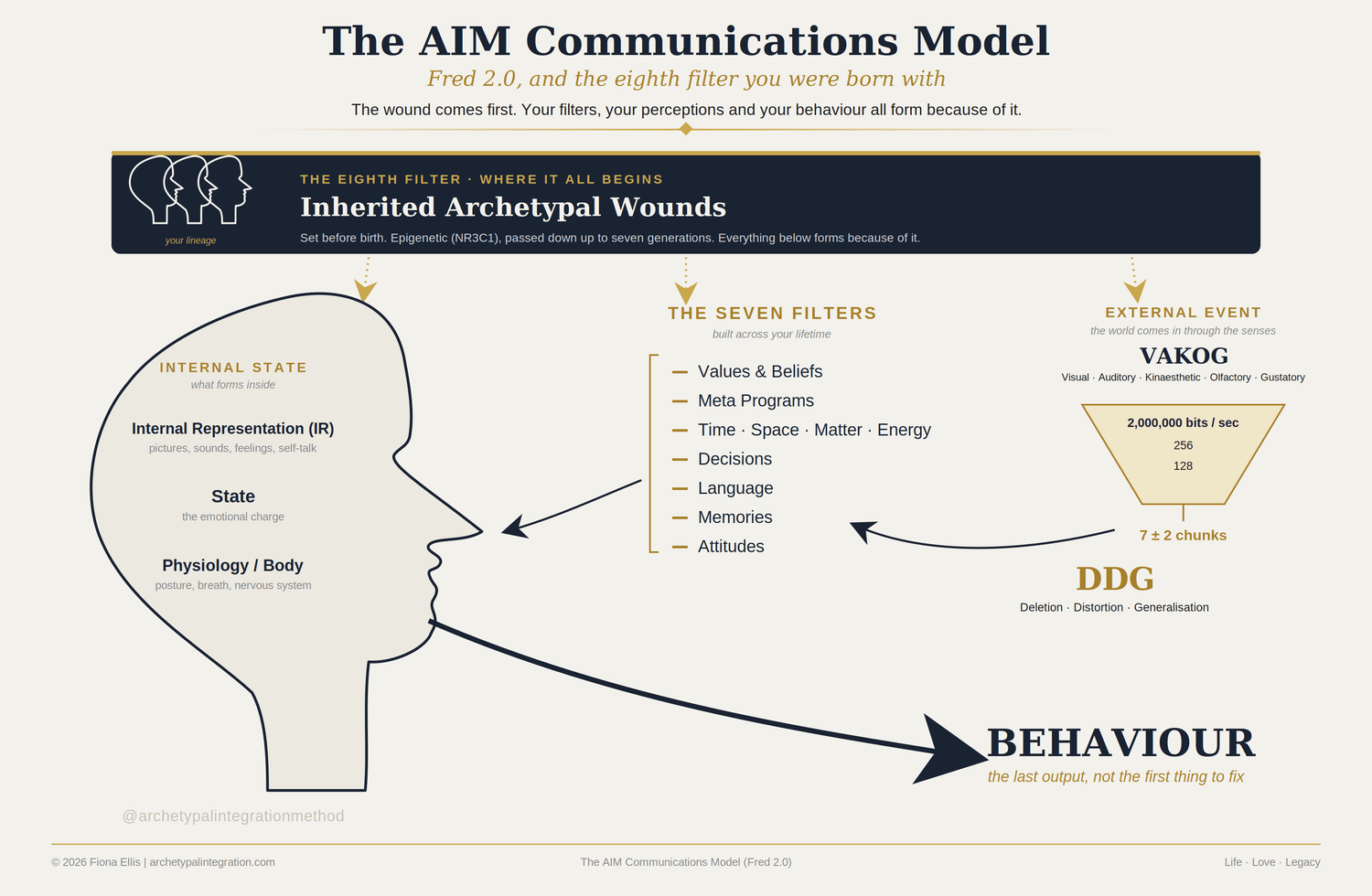
So here is what I am proposing — and what twenty years of working with human minds has confirmed long before the science caught up.
The standard NLP Communications Model has seven filters. They are real, they are powerful, and they are the foundation of understanding human behaviour.
But there is an eighth.
Inherited Archetypal Wounds.
These are the deletion, distortion, and generalisation patterns that were not installed by your own experiences — but passed to you through your lineage. Your grandmother’s terror. Your grandfather’s shame. The Victorian repression that taught your great-great-grandmother that desire was dangerous. The Industrial Revolution that taught your great-grandfather that his worth was measured in output. The collapse of masculine and feminine polarity that left your parents unable to model integrated partnership.
These inherited patterns sit beneath the seven standard filters. They are the settings your gatekeeper was born with — the rules she was already running before you had a single experience of your own.
This is why you can do all the personal development in the world — clear your memories, rewrite your beliefs, examine your values, update your decisions — and still hit the same wall. Because underneath your filters are your family’s filters. And underneath your family’s filters are your culture’s filters. And those go back generations.
When I flinch at someone I have no personal reason to fear, I am not running my own filter. I am running an inherited one. A pattern that was useful for someone in my lineage — and that was passed down through the biology because the nervous system decided it was important enough to keep.
The NLP Communications Model says: behaviour is the last output. Change the filters, change the behaviour.
The Archetypal Integration Method™ says: some of those filters are not yours. And you cannot change a filter you don’t know you’re carrying.
That is the eighth filter. And that is what the sixty-eight archetypes in the Archetypal Wounds Oracle Deck™ were built to name.
The Failed Provider. The Unclaimed Queen. The Silent King. The Suppressed Siren. The Mechanical Man. Every one of them is an inherited filter set — a specific pattern of deletion, distortion, and generalisation that was passed down through your lineage and is now running your NLP Communications Model without your knowledge or consent.
You are not broken. You are not undisciplined. You are not failing at change.
You are carrying inheritance. And now that you know the filter exists — you can finally do something about it.
In the next article, I’ll take you upstream — to the question that Indigenous healers have always asked first, long before Western psychology arrived with its symptom checklists: not “what is wrong with you?” but “what did you lose connection to?”
Want the full chapter?
This article is adapted from You Can’t Get There From Here.
The book contains the complete eighth filter theory, the NR3C1 stress thermostat, and the science of inherited trauma across generations.
Get the BookGo Deeper
The eighth filter — inherited archetypal wounds — is the subject of Chapters 1 and 2 of You Can’t Get There From Here: Healing the Inheritance You Didn’t Ask For. The NLP Communications Model and its seven standard filters are taught in Chapter 3. Together, they form the foundation of the Archetypal Integration Method™.
You Can’t Get There From Here
Healing the Inheritance You Didn’t Ask For
The science, the history, and the map. If the filters running your life aren’t yours — this is how you find out whose they are.
Get the BookThe Archetypal Wounds Oracle Deck™ & Guidebook
68 inherited filter patterns. Named. Mapped. Ready to integrate.
Includes the full guidebook with shadow beliefs, sovereign reframes, and integration practices for every archetype.
Pull a card. Name the filter. Begin the work.
Get the DeckThe NLP Communications Model is a foundational framework from Neuro-Linguistic Programming, originally developed by Richard Bandler and John Grinder. The concept of the eighth filter — inherited archetypal wounds as a distinct filtering mechanism within the NLP Communications Model — is original to the Archetypal Integration Method™ developed by Fiona Ellis. The epigenetic research cited in this article includes: Dias & Ressler (2013), Nature Neuroscience; the Dutch Hunger Winter cohort studies; Yehuda et al., Mount Sinai Holocaust intergenerational trauma research; Dajani et al. (2025), Scientific Reports; Kac, Qi & Ryznar (2026), Frontiers in Psychiatry; and the PMC systematic review on transgenerational trauma (2026).
If any of this work resonates and helps you at all, please feel free to donate to my diesel (and possibly future legal defence) fund: ko-fi.com/fionaellis
About the Author
Fiona Ellis is the creator of the Archetypal Integration Method™ and the Archetypal Wounds Oracle Deck™. She is a Master Trainer of Shamanic NLP, published author, and keynote speaker working at the intersection of inherited cultural trauma, epigenetics, and practical integration. Her books You Can’t Get There From Here and Archetypal Wounds are available now.
archetypalintegration.com | Keynote Speaking | The Deck
Learn more about inherited archetypal wounds and the eighth filter in You Can’t Get There From Here. Visit archetypalintegration.com/books-decks to order.
Life · Love · Legacy
Bridging spirituality, science, and psychology for those ready to understand what's been running beneath the surface — and choose differently.
The Archetypal Integration Method™ (AIM) is a proprietary framework developed by Fiona Ellis that bridges archetypal psychology, cultural trauma theory, and Shamanic NLP to address inherited patterns passed through up to seven generations.
© 2026 Fiona Ellis | archetypalintegration.com | Perth, Western Australia
archetypalintegrationmethod@gmail.com
The content on this website is for educational and informational purposes only and is not a substitute for professional medical, psychological, or therapeutic advice, diagnosis, or treatment. Fiona Ellis is not a licensed psychologist, psychiatrist, or medical practitioner. The Archetypal Integration Method is a coaching and personal development framework. Always seek the advice of a qualified health provider with any questions regarding a mental or physical health condition. Use of this website, its content, courses, and associated materials is at your own discretion and risk.
All Rights Reserved.