
Your Behaviour is the Symptom Not the Problem
Your Behaviour Is Not the Problem
The NLP Communications Model Explained
By Fiona Ellis | Chapter 3 companion — You Can't Get There From Here
Right now — before you read another word — notice the feeling of whatever you're sitting or standing on.
Now notice a sound you weren't paying attention to a moment ago.
Now notice the colour of the background behind this text. The temperature of the air on your skin. The rhythm of your own breathing. The pulse ticking in your wrist.
You could keep going. The smell in the room. The weight of your phone or the pressure of your fingers on the keyboard. The colour of the wall to your left. A sound from outside. A sound from inside your own body.
There are millions of bits of sensory information coming at you every single second. Millions. If you had to consciously notice all of them at once — you would melt. You could not function. You couldn't finish this sentence, let alone hold a conversation, drive a car, or make a decision.
So your brain does something extraordinary. It filters. It decides — in milliseconds, without asking your permission — what is important and what is not. What gets through, and what gets deleted.
This is the NLP Communications Model in action. And it is running your entire life.
Meet Fred
In the world of Neuro-Linguistic Programming, there is a model that maps the entire journey of how a human being takes in an external event and turns it into a behaviour. It is one of the most important diagrams I have ever encountered in twenty years of working with human minds.
We call him Fred. Fred The Head.
Here is what Fred teaches us: you do not experience the world as it is. You experience the world as you are.
Everything you see, hear, feel, smell, and taste passes through a series of filters before it ever reaches your conscious awareness. By the time you "experience" something, it has already been edited. Cut. Reshaped. What arrives in your mind is not reality. It is your version of reality — and everyone's version is different.
In the last article, I showed you the Logical Levels of Change — and why working at the behaviour level rarely lasts. The NLP Communications Model shows you why behaviour sits at the surface. It is the last output in a chain that started long before you opened your mouth, clenched your fist, poured the drink, or sent the text.
The full sequence looks like this:
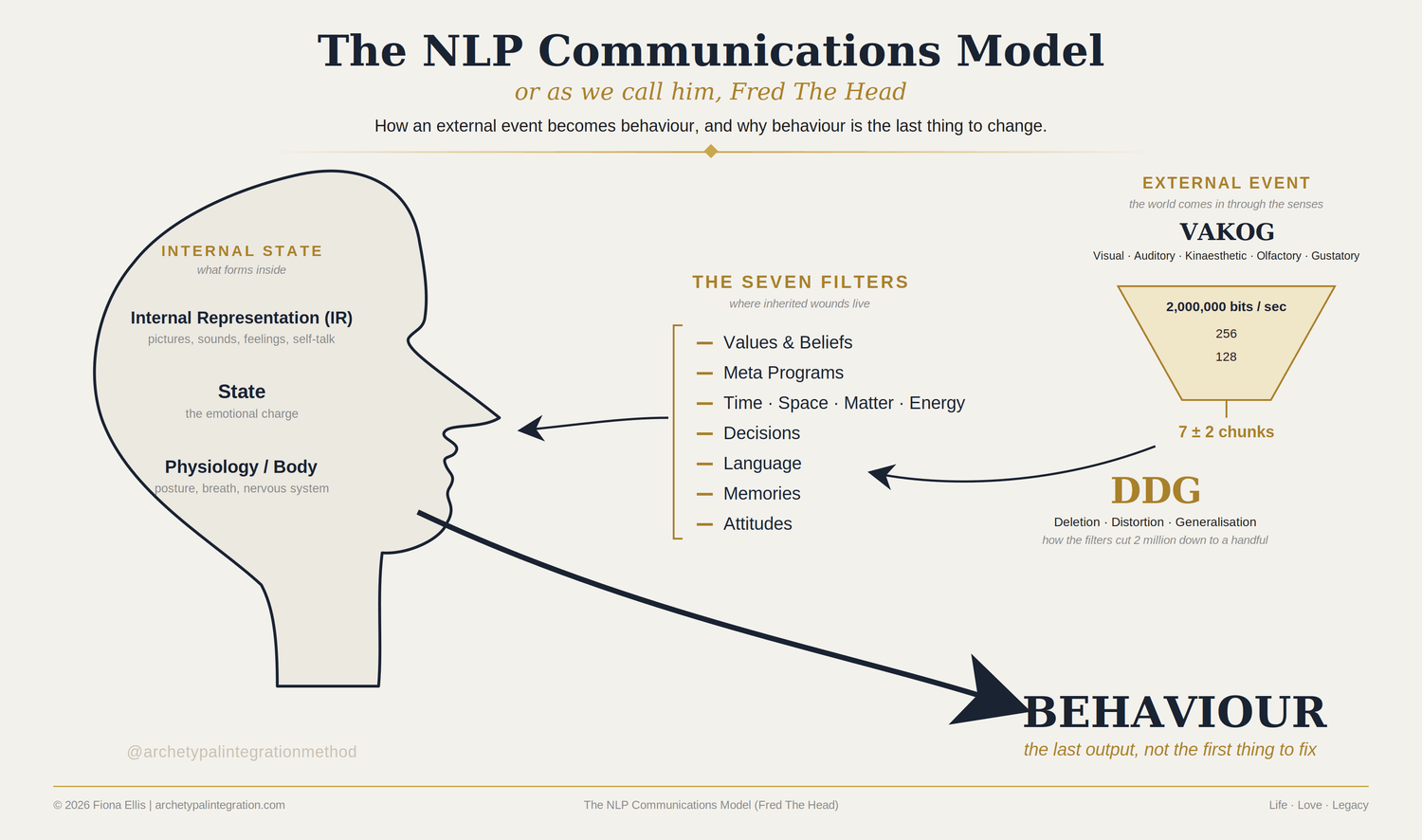
External Event → Filters → Internal Representation → State → Physiology → Behaviour
Behaviour is the last thing. Not the first. Not the cause. The symptom.
The World's Best Gatekeeper
Imagine the world's best executive assistant. If you've ever worked in corporate — or tried to get a conversation with a CEO — you've met her. She is a career gatekeeper. Nothing and nobody gets past her without meeting her criteria. She has a set of rules, a set of non-negotiables about who gets in and who doesn't. She didn't make those rules up this morning. She's been refining them for decades.
That is what is happening inside your brain. Every second of every day. Your filters are the gatekeeper. They decide what information gets through to the CEO — your conscious mind — and what gets turned away at the door.
The NLP Communications Model calls this process DDG: Deletion, Distortion, and Generalisation.
The Garden
Here is the simplest way I can explain DDG.
You look at a garden. There are weeds.
Deletion says: What weeds? I don't see any weeds. The information was there. Your filters removed it before you noticed.
Distortion says: They're not weeds — they're feeding the bees. The information was there. Your filters changed what it meant.
Generalisation says: Everybody has weeds. That's just what gardens look like. The information was there. Your filters applied one experience to everything.
That is DDG. Your brain takes millions of bits of incoming data and consolidates them down into roughly seven manageable chunks — deleting what it considers unimportant, distorting what doesn't fit, and generalising from what it already believes is true.
Seven. It's not a coincidence that the number shows up everywhere. Seven wonders of the world. Seven days of the week. Seven dwarves. Try it now — name as many countries as you can without stopping. Most people hit about seven before they have to pause and reach back in for more. That's your filters at work, deciding what's accessible and what isn't.
But here's the question that changes everything: who decided what's important?
The Filters Behind the Filters
Within the NLP Communications Model, your DDG patterns don't operate randomly. They are shaped by seven deeper filters — the rules your gatekeeper is operating by. These are the filters that make your experience of reality uniquely yours:
Time, Space, Matter, and Energy. Are you exhausted or energised? Is it midday or midnight? Are you in an open park or a narrow corridor? These change constantly — and they change what your filters let through.
Memories. And here's where it gets interesting — because your memories are already filtered. They are already a deleted, distorted, and generalised version of what actually happened. Have you ever argued with a sibling about the same family event? "No, that's not what happened — this is what happened." And from each of your perspectives, you are both completely right. Because you both filtered the same event through different deletion, distortion, and generalisation patterns. Your memory of the event isn't the event. It's your gatekeeper's version of it.
Language. Do you even have words for the experience? If you don't speak the language of accounting, tax time feels like trepidation. If you're a career accountant who lives in that world, tax time feels like excitement. Same event. Different language filter. Different experience entirely.
Beliefs. What you hold as true about yourself, others, and the world. Money is hard. Rest is lazy. People leave. Creativity is frivolous. I have to earn love. You didn't choose most of these. They were installed — by your family, your culture, and in many cases, by wounds you inherited from generations before you. A belief is not a fact. It is a filter. And it will delete, distort, and generalise every incoming event to confirm itself.
Values. What you hold as important — in hierarchical order. Security. Freedom. Achievement. Connection. Control. Here is what most people don't realise: the values you think are driving you are often not your genuine values at all. They are what I call the Hope Set — the things you chase because you lacked them, not because they're truly yours. Someone who grew up without safety will put "security" at the top of their list — not because security is their deepest truth, but because its absence was their deepest wound. And underneath the hope set sits the Sabotage Set — the values that actually win when you're tired, stressed, or overwhelmed. Convenience. Comfort. Certainty. The values that override your goals every single time. Your gatekeeper doesn't run on the poster on your wall. She runs on what actually matters under pressure.
Decisions. Not the events themselves — the meaning you made from them. "I'll never let anyone see me cry." "If I stay small, I stay safe." These were often made in childhood, under stress, with a child's logic — and they are still filtering every experience you have as an adult.
Meta Programs. Your unconscious sorting patterns. Do you move toward what you want or away from what you fear? Do you trust your own compass or look to others for validation? Do you see the big picture or start with details? These aren't personality types. They're processing preferences — and most of them were installed before you could talk.
Every one of these seven filters is shaping what gets through to you and what doesn't. Every one of them is deciding, in milliseconds, what your version of reality looks like.
The Alleyway
Let me make this real.
Picture an alleyway. Narrow. Brick walls on both sides.
Now picture walking through it on a sunny afternoon in Melbourne. You're looking for street art. Hidden cafes. A bar someone told you about that doesn't have a sign. The alleyway is an adventure. Your body is relaxed. Your pace is easy. You're curious.
Now picture the same alleyway at midnight. Alone. The only light is a flickering globe at the far end. Something moves in the shadows.
Same alleyway. Same bricks. Same physical space.
Completely different experience. Completely different body. Completely different behaviour.
The alleyway didn't change. Your filters changed. Time, space, memory, beliefs about safety — every filter in the NLP Communications Model shifted, and so the internal representation shifted, and so your state shifted, and so your behaviour shifted. You went from strolling to frozen. From curious to hypervigilant. Not because of the alleyway. Because of what your gatekeeper decided the alleyway meant.
This is the NLP Communications Model in a single image. The external event is neutral. The filters make it personal.
What Happens After the Filters
Once the external event has been filtered — once your gatekeeper has decided what gets through and what it means — your brain presents you with an image. An internal representation. This is what you see, hear, and feel inside your mind.
And this is where phobias live. I can say the word "spider" to someone who is phobic, and their mind will show them every detail — huge, hairy, crawling. Someone else hears the same word and pictures a tiny garden spider sitting in a web catching morning dew. Same word. Same external event. Completely different internal representation. Because the filters are different.
That internal representation instantly triggers a physiological response. Your body doesn't wait for your rational mind to weigh in. It floods you — fight, flight, freeze, fawn — before you've had a chance to think about it. This is your state. And your state drives the behaviour.
This is happening in milliseconds. You walk into a room, hear a tone of voice, see a facial expression — and every memory, every belief, every decision, every filter fires at once. Your body responds. Your limbs move. Your mouth opens. That's the behaviour. The last thing in the chain.
The Real Question
When Western medicine tries to treat nicotine addiction by switching from cigarettes to gum, it is treating the behaviour. When it tries to treat anxiety by prescribing a pill, it is treating the state. Both of these are downstream.
It is the equivalent of finding an infected wound on your arm and covering it with a bandage. The bandage might hide it. But the infection underneath hasn't been addressed. And it will surface again — somewhere.
The NLP Communications Model shows us where to actually look.
Not: Why do I keep doing this? — that leads to shame spirals.
But: How did I just decide that this equals danger? Or excitement. Or shutdown. Or obsession.
How. Not why. How did the filters work? What did the gatekeeper let through — and what did she block? What memory, what belief, what inherited decision shaped the internal representation that created the state that produced the behaviour?
Because once you can see the how, you can change the process. You can update the filters. And the behaviour — the thing you've been fighting, blaming, medicating, and white-knuckling your way through — changes on its own. Because it was never the problem. It was always the last thing.
But here is what the standard NLP Communications Model doesn't account for — and what twenty years of working with human minds has shown me is the missing piece.
What if some of your filters aren't yours? What if the beliefs, the memories, the decisions shaping your gatekeeper were inherited — not from your own experience, but from your parents, your grandparents, and their parents before them? What if your body is flinching at things that happened to someone else, three generations ago?
In the next article, I'll introduce you to the eighth filter — the one that turns the NLP Communications Model into something far more powerful. And far more honest.
Go Deeper
The NLP Communications Model is one of several frameworks I teach in Chapter 3 of You Can't Get There From Here: Healing the Inheritance You Didn't Ask For — alongside the Logical Levels of Change, the Reticular Activating System, and the walk upstream. The values filter is explored in depth through the Integrated Values Matrix™ (IVM) — a five-layer system for distinguishing between wound-driven values and genuine ones.
You Can't Get There From Here
Healing the Inheritance You Didn't Ask For
If the patterns run deeper than habits and you know it — this is the map.
Get the BookThe Archetypal Wounds Oracle Deck™ & Guidebook
68 inherited filter patterns. Named. Mapped. Ready to integrate.
The inherited filter patterns running your NLP Communications Model — named, mapped, and ready to integrate.
Get the DeckThe NLP Communications Model is a foundational framework from Neuro-Linguistic Programming, originally developed by Richard Bandler and John Grinder. We call him Fred The Head — a teaching shorthand from my NLP training that stuck. The application of the NLP Communications Model to inherited archetypal wounds, epigenetic filter transmission, and the Faultline mechanism is original to the Archetypal Integration Method™.
If any of this work resonates and helps you at all, please feel free to leave a tip: ko-fi.com/fionaellis
About the Author
Fiona Ellis is the creator of the Archetypal Integration Method™ and the Archetypal Wounds Oracle Deck™. She is a Master Trainer of Shamanic NLP, published author, and keynote speaker working at the intersection of inherited cultural trauma, epigenetics, and practical integration. Her books You Can't Get There From Here and The Archetypal Wounds Guidebook are available now.
archetypalintegration.com | Keynote Speaking | The Deck
Learn more about the NLP Communications Model and inherited filter patterns in You Can't Get There From Here. Visit archetypalintegration.com/books-decks to order.
Life · Love · Legacy
Bridging spirituality, science, and psychology for those ready to understand what's been running beneath the surface — and choose differently.
The Archetypal Integration Method™ (AIM) is a proprietary framework developed by Fiona Ellis that bridges archetypal psychology, cultural trauma theory, and Shamanic NLP to address inherited patterns passed through up to seven generations.
© 2026 Fiona Ellis | archetypalintegration.com | Perth, Western Australia
archetypalintegrationmethod@gmail.com
The content on this website is for educational and informational purposes only and is not a substitute for professional medical, psychological, or therapeutic advice, diagnosis, or treatment. Fiona Ellis is not a licensed psychologist, psychiatrist, or medical practitioner. The Archetypal Integration Method is a coaching and personal development framework. Always seek the advice of a qualified health provider with any questions regarding a mental or physical health condition. Use of this website, its content, courses, and associated materials is at your own discretion and risk.
All Rights Reserved.