Why Your Change Doesn't Stick — Logical Levels of Change | Fiona Ellis
You've done the courses. Read the books. Written the affirmations on your mirror. Maybe even cried in a workshop and felt something shift.
And for about three weeks, it worked.
Then it didn't.
The old pattern crept back in. The same argument. The same spiral. The same 2am doom scroll when you know you should be sleeping. The same financial ceiling. The same relationship dynamic wearing a different face.
You blame yourself. You weren't disciplined enough. Didn't want it badly enough. Need to try harder, do more, be better.
Here's what twenty years of working with human minds has taught me: it's not a discipline problem. It's a depth problem.
And there's a model that explains exactly why.
Meet the Logical Levels of Change
In the world of Neuro-Linguistic Programming, Robert Dilts — building on the work of anthropologist Gregory Bateson — mapped the layers at which human change actually happens.
Not all change is created equal. Some changes are surface. Some are structural. And the level you're working at determines whether the shift lasts three weeks or the rest of your life.
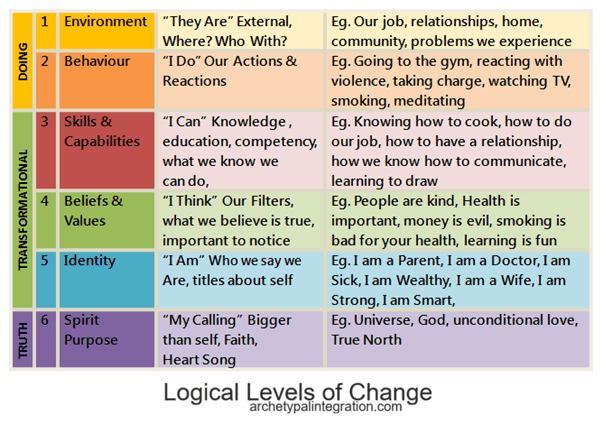
There are six levels. They run from the most visible to the most invisible — from what the world sees to what only you feel.
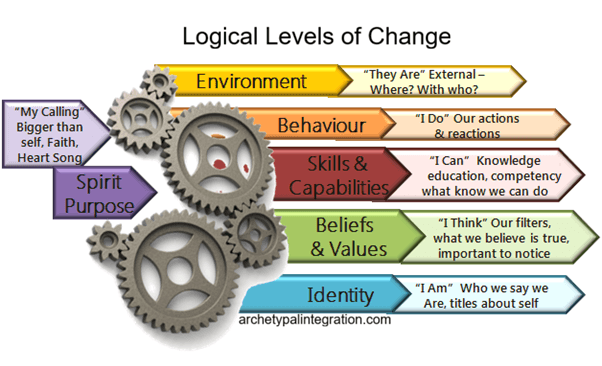
Level 1 — Environment
Where you are. Everything external to you.
Your job, your home, your relationships, the people around you, the physical circumstances of your life. This is what others observe from the outside. It's the most visible level and the easiest to change — but also the least powerful.
Level 2 — Behaviour
What you do.
Your habits, your actions, your reactions. Going to the gym. Doomscrolling. Snapping at your partner. Pouring the drink. This is the level most coaching, therapy, and self-help targets first. And this is where most of it fails.
Level 3 — Skills & Capabilities
What you can do.
Your knowledge, your education, your competency. What you've been trained in, what you know how to execute. You might have the belief that health matters — but if nobody taught you to cook, the belief has no vehicle.
Level 4 — Beliefs & Values
What you think is true. What matters.
This is where the filters live. Health is important. Money is evil. Creativity is frivolous. People can't be trusted. Rest is lazy. You didn't choose most of these. They were installed — by your family, your culture, your wounds. These filters are where your archetypal wounds live. They are the inherited deletion, distortion, and generalisation patterns passed down through your lineage.
Level 5 — Identity
Who you say you are.
The "I am" statements. I am a mother. I am successful. I am broken. I am not creative. I am the strong one. I am not the kind of person who asks for help. These run deeper than beliefs — they define the container that beliefs and behaviours are allowed to exist within.
Level 6 — Spirit / Purpose
Why you exist.
Your soul song. Your calling. The thing bigger than you that pulls you forward even when every other level is screaming to stop. This is where legacy lives. This is where the seven-generation vision sits. And for many people, this level has been buried so deep under cultural conditioning that they've forgotten it was ever there.
The Principle That Changes Everything
Here it is, plainly:
The deeper you go, the more powerful the change.
The shallower you stay, the more willpower it costs.
Surface changes — rearranging your environment, forcing new behaviours — require constant effort. You are swimming against the current of everything below. Your beliefs don't support the behaviour. Your identity doesn't recognise the new version of you. Your purpose hasn't shifted. So the system pulls you back to what matches.
Deep changes — at identity, belief, and purpose level — create automatic transformation. When "I am someone who takes care of my body" becomes genuinely true at Level 5, the behaviour at Level 2 follows without a fight. You don't force yourself to the gym. You go because it's who you are. The willpower disappears because there's nothing to resist.
This is why telling someone to "just stop" doing something never works. You are addressing the end of the chain. Behaviour is downstream. Identity is upstream. Purpose is the source.
Where This Model Meets the Faultline
In You Can't Get There From Here, I introduce a concept called the Faultline — the invisible psychological split that forms when a developing child encounters two environments with mutually incompatible rules for survival.
Each side of that split — the Cultivated Adult Self and the Protector Child Self — operates at different Logical Levels. They have different beliefs. Different capabilities. Different identity statements. Different values. And critically, different behaviours.
The Cultivated Adult Self might hold "I am capable, I can handle this" at Level 5. The Protector Child Self, frozen at the age the split occurred, might hold "I am not safe unless I stay small" at the same level. Both are running simultaneously. Both are influencing the environment — the clothes you wear, the jobs you take, the relationships you choose, the goals you set — without access to the full picture of what is now true and ideal for your functional whole.
This is why you can know exactly what to do and still not do it. The adult self has the knowledge at Level 3. The child self has the override at Level 5. Identity trumps capability every time.
The Faultline is not a mindset problem. It's a Logical Levels problem. And it explains why no amount of new behaviour or new skills will hold if the identity beneath them is still split.
The Creativity Example
Let me make this concrete.
Say you grew up in a family where creativity wasn't valued. Where the message — spoken or not — was "be sensible, get a real job, art is a luxury we can't afford."
At Level 5 (Identity), you carry: "I am not creative."
At Level 4 (Beliefs), you carry: "Creativity is frivolous. Sensible people survive."
At Level 3 (Skills), you never learned to draw, play music, write for pleasure.
At Level 2 (Behaviour), you don't take art classes, don't paint, don't play.
At Level 1 (Environment), your home has no evidence of creativity in it.
Now someone tells you to "try journalling" or "take a pottery class." They're targeting Level 2 — behaviour. Maybe Level 3 — a new skill.
But Levels 4 and 5 haven't moved. The identity still says "I am not creative." The belief still says "creativity is frivolous."
So you go to the pottery class. You enjoy it. For three weeks.
Then you stop. Not because you're lazy. Because every level below the behaviour is pulling you back to the version of yourself that matches the deeper code.
Your change didn't fail because you didn't want it enough. It failed because you were working at the wrong level.
Why This Matters for Healing — Not Just Goal-Setting
Most personal development works exclusively at Levels 1 through 3. Change your environment. Change your habits. Learn new skills. Set SMART goals.
And it works — temporarily. Until the deeper levels reassert themselves.
What I teach through the Archetypal Integration Method™ is change at Levels 4, 5, and 6. Not by adding more information. Not by forcing new behaviours. But by clearing the inherited beliefs, the wound-driven identity statements, and the cultural conditioning that keeps the deeper levels locked in survival mode.
The NLP Communications Model — or as I call him, Fred The Head — shows us that behaviour is the last output in the processing chain. The Logical Levels model shows us why: behaviour sits near the surface. Everything below it — capabilities, beliefs, identity, purpose — determines what that behaviour will be.
If you want lasting change, you don't start with what you do. You start with who you believe you are. And more importantly — you start with understanding where that belief came from and whether it's actually yours.
The Real Question
This is not "what habits should I build?" That's Level 2 thinking.
This is not "what do I need to learn?" That's Level 3 thinking.
The real question — the one that actually changes your life — is:
Who am I when I stop performing the version of me that someone else's wound created?
That's Level 5. That's where the work begins. And that's where I take you in the book.
Go Deeper
The Logical Levels model is one of several frameworks I teach in Chapter 3 of You Can't Get There From Here: Healing the Inheritance You Didn't Ask For — alongside the NLP Communications Model (Fred The Head), the Reticular Activating System, and the concept that started my entire career: the walk upstream.
You Can't Get There From Here
Healing the Inheritance You Didn't Ask For
If you recognise yourself in what you've just read — if the patterns run deeper than habits and you know it — this is the map.
GET THE BOOKThe Logical Levels model is attributed to Robert Dilts, developed from Gregory Bateson's logical levels of learning. The application to inherited wounds and the Faultline mechanism is original to the Archetypal Integration Method™.
If any of this work resonates and helps you at all, please feel free to donate to my diesel (and possibly future legal defence) fund: ko-fi.com/fionaellis
About the Author
Fiona Ellis is the creator of the Archetypal Integration Method™ and the Archetypal Wounds Oracle Deck™. She is a Master Trainer of Shamanic NLP, published author, and keynote speaker working at the intersection of inherited cultural trauma, epigenetics, and practical integration. Her books You Can't Get There From Here and The Archetypal Wounds Guidebook are available now.
© 2026 Fiona Ellis | archetypalintegration.com
Life · Love · Legacy
Bridging spirituality, science, and psychology for those ready to understand what's been running beneath the surface — and choose differently.
The Archetypal Integration Method™ (AIM) is a proprietary framework developed by Fiona Ellis that bridges archetypal psychology, cultural trauma theory, and Shamanic NLP to address inherited patterns passed through up to seven generations.
© 2026 Fiona Ellis | archetypalintegration.com | Perth, Western Australia
archetypalintegrationmethod@gmail.com
The content on this website is for educational and informational purposes only and is not a substitute for professional medical, psychological, or therapeutic advice, diagnosis, or treatment. Fiona Ellis is not a licensed psychologist, psychiatrist, or medical practitioner. The Archetypal Integration Method is a coaching and personal development framework. Always seek the advice of a qualified health provider with any questions regarding a mental or physical health condition. Use of this website, its content, courses, and associated materials is at your own discretion and risk.
All Rights Reserved.