Civilisation Progression Model — Separated, Connected, Interconnected, Integrated | Fiona Ellis
Civilisation Progression Model
Separated, Connected, Interconnected, Integrated
By Fiona Ellis | You Can’t Get There From Here
📖 From the Book
Adapted from Chapter 1: You Can't Get There From Here
You Can’t Get There From Here — Healing the Inheritance You Didn’t Ask For
Order your copy →Why does it feel like the whole world is falling apart right now?
Not just in your life — in the systems around you. In the authority we thought we could trust. In the institutions that were supposed to protect us. In the leaders who were supposed to lead.
There are glimmers of hope — real ones. But why does it feel like the old rules aren’t working and the new ones haven’t arrived yet?
Part of it is our suppressed emotions — the way we’ve been taught to stuff down our anger, our grief, our outrage instead of using them as the directional signals they were designed to be. I wrote about that here.
But there’s something bigger happening underneath the emotional surface. Our civilisation is changing. Not metaphorically. Structurally. And whether we evolve forward or totally regress back depends on whether we can see the pattern clearly enough to choose.
There is a model for this. I call it the Civilisation Progression Model. And once you see it, you will never look at the news the same way again.
The Four Stages
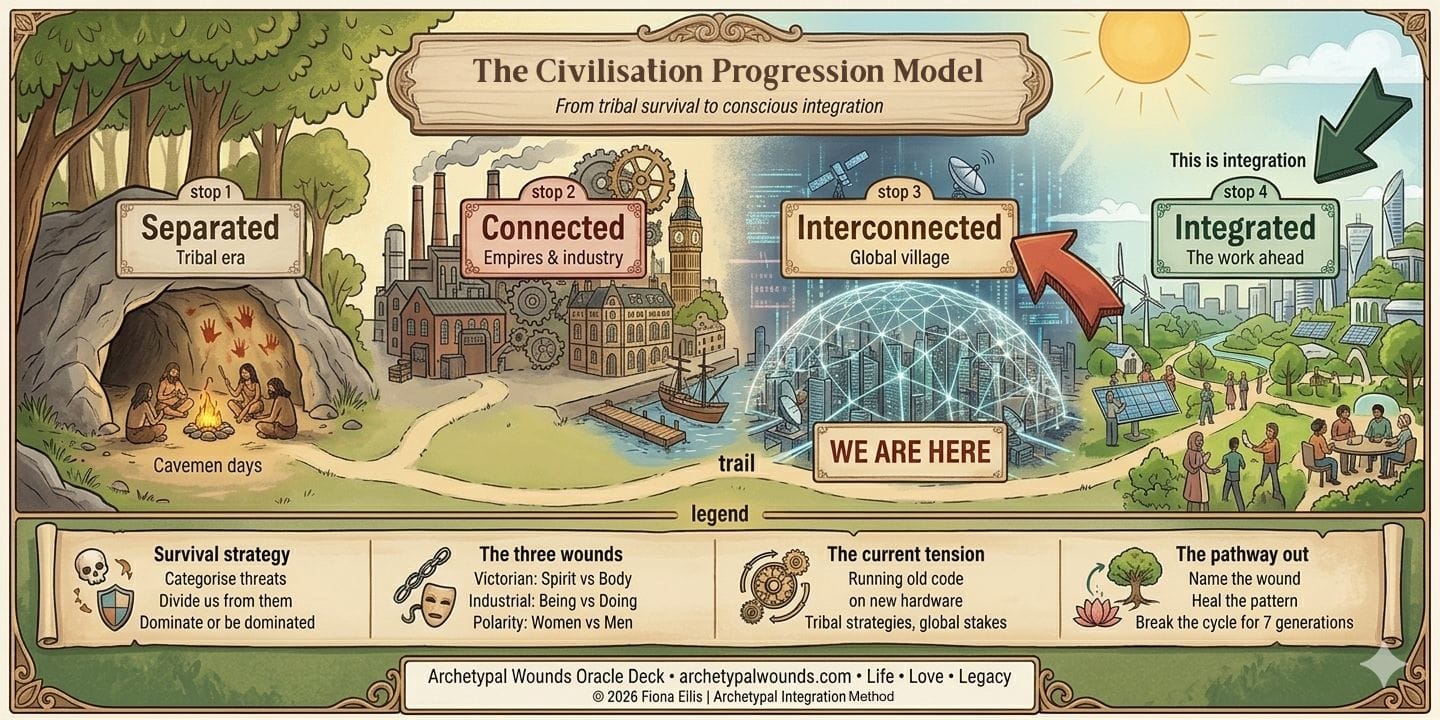
Separated → Connected → Interconnected → Integrated
Every human civilisation — every family, every organisation, every relationship — sits somewhere on this progression. And the tension you’re feeling right now is the friction of a system trying to move from one stage to the next while a significant part of it is pulling backward.
Stage One: Separated
This is where we started. Tribal. Walled. Local. Us and them.
In a Separated system, survival depends on categorising quickly. Who is safe? Who is dangerous? Who is inside the walls? Who is outside? These judgments aren’t character flaws — they are survival technology. When your tribe is fifty people and the next tribe over wants your water, the ability to categorise friend from foe instantly is the difference between living and dying.
Separated systems produce order. They produce cohesion. They produce a version of peace — tribal peace, local peace, held together by walls, roles, and the suppression of anything that threatens the structure.
They also produce the Victorian Era Wound, the Industrial Factory Wound, and the Polarity Collapse. Because categorising, dividing, and competing is how Separated systems maintain control.
Stage Two: Connected
When tribes begin to trade, communicate, and recognise each other’s existence, they become Connected. Roads are built. Languages overlap. Commerce creates mutual dependency. You no longer kill the other tribe on sight — because they have something you need.
But Connected is not harmonised. It’s strategic coexistence. Think Cold War alliances. Trade partnerships between countries that fundamentally distrust each other. Corporate mergers where the cultures never integrate. Marriages where two people share a house but not a life.
Connected systems still operate on Separated-era software: categorise, divide, compete. They’ve just added a thin layer of diplomacy on top. The walls are still there — they’re just less visible.
Stage Three: Interconnected
This is where the internet changed everything. Suddenly every system on the planet is linked. Financial markets in Tokyo affect grocery prices in Perth. A pandemic in one province becomes a global emergency in weeks. A teenager’s video reaches fifty million people before the news cycle catches up.
Interconnected means you cannot insulate yourself from the consequences of anyone else’s decisions. Your supply chain runs through twelve countries. Your pension fund is invested in industries you’ve never heard of. Your children are being influenced by content creators on the other side of the world.
But here’s the problem: we are running Interconnected-era hardware with Separated-era software. The systems require cooperation across every border, belief, and identity — but the operating code running most institutions, governments, and nervous systems is still: categorise, divide, compete.
That mismatch is what you’re feeling right now. That’s the friction. That’s why it feels like things are falling apart — because the old operating system is crashing, and the upgrade hasn’t been installed yet.
Stage Four: Integrated
Integration is not the absence of difference. It is the conscious practice of holding difference without needing to suppress it, dominate it, or destroy it.
An Integrated system doesn’t pretend everyone is the same. It doesn’t flatten identity into uniformity. It holds masculine and feminine without collapsing either. It holds individual sovereignty and collective responsibility without sacrificing one for the other. It holds science and spirituality, logic and intuition, strength and vulnerability — without choosing sides.
Integration is not a destination. It is a practice. The same principle that runs through the Archetypal Integration Method™ at the personal level — descent into the wound IS the rise into self, both true simultaneously — applies at the civilisational level. The discomfort is the upgrade. The friction is the process. The collapse of old structures is what makes space for new ones.
We are not there yet. But the map exists.
How We Got Here
Long before we had a developed neocortex — before scientific data, education, or global connectivity — humans survived by doing three things: categorising, dividing, and competing.
These strategies didn’t emerge from nowhere. They evolved from our relationship with every other species on the planet.
We learned to categorise to survive. Sabre-toothed tiger: dangerous, avoid. Snake in the grass: threat, kill on sight. These rapid-fire judgments kept us alive. We split the world into safe and unsafe, useful and dangerous, us and them — and that binary thinking became the foundation of every system we built afterward.
Then we learned to dominate. We took wild animals and broke them into compliance. We bred cattle for docility. We fenced them, fed them on schedule, removed their ability to roam, and trained them to follow the herd. We called it domestication. The animals that resisted were destroyed. The ones that complied were kept alive — useful, productive, controlled.
And then — somewhere along the line — we turned those same techniques on each other.
Categorise people into roles. Separate them from their instincts. Reward compliance. Punish deviation. Remove the wildness. Keep them productive. Keep them moving through the system. Don’t let them stop long enough to question the fence.
At a tribal level, it worked. Categorising people created order. Dividing “us” from “them” created cohesion. Pitting groups against each other created motivation. These weren’t character flaws — they were survival technology. And for thousands of years, they produced a version of peace. Tribal peace. Local peace. Peace held together by walls, roles, and the suppression of anything that threatened the structure.
But we don’t live in separated tribes anymore.
The Old Operating System
The three core wounds that I map in my work — the Victorian Era Wound, the Industrial Factory Wound, and the Feminism Polarity Collapse — are not random cultural injuries. They are the installation log of the Separated operating system applied to modern civilisation.
The Victorian Wound categorised us: spirit vs body, desire vs duty, pure vs fallen.
The Industrial Wound divided us: being vs doing, worth vs output, human vs machine.
The Polarity Collapse pitted us against each other: women vs men, independence vs intimacy, strength vs softness.
Same ancient architecture. Same domestication playbook. Just wearing modern clothes.
The shadow belief of the Industrial Wound — “You are only worthy if you are productive or useful” — is not a personal failing. It is the voice of a Separated-era system still running in an Interconnected-era world. It was designed to keep the components moving through the factory. It was never designed for a human being trying to rest, to connect, to create, to love.
Why This Matters for Leadership
Every leadership crisis you’re watching right now — political, corporate, institutional — is the Civilisation Progression Model in action. Leaders running Separated-era code in an Interconnected-era system. Categorise, divide, compete. Build walls. Blame the other side. Reward compliance. Punish deviation.
It worked when the world was tribal. It is catastrophic when the world is interconnected.
The same pattern shows up in organisations. Two companies merge and the cultures never integrate — because the leadership is still running Separated software. A team restructures and the silos get deeper instead of dissolving — because the operating system hasn’t been updated. A government promises unity and delivers division — because the only code it knows is categorise, divide, compete.
It shows up in AI too. We built artificial intelligence using the same Separated-era architecture: categorise data, divide it into patterns, compete for the most efficient output. The question is whether AI inherits our old operating system — or whether we use the mirror it provides to finally see the code we’ve been running and choose to upgrade.
That is the Faultline scaled to civilisation. The same mechanism that creates a parts split in an individual — irreconcilable rule conflict under pressure — is creating a civilisational split right now. The pressure is building. The developmental moment has arrived. And the eruption is already happening.
The Choice
You can feel it because you’re living in it. The tension between the world that was and the world that’s trying to emerge. The frustration of watching old systems fail and not yet being able to see what replaces them.
The Civilisation Progression Model doesn’t promise that integration is inevitable. It shows that it’s possible — and that the friction is the process, not the failure.
The personal version of this model is the work I teach through the Archetypal Integration Method™. The sixty-eight inherited wound patterns are the Separated-era software running in your nervous system. The three core wounds are the installation log. The Faultline is where the pressure erupts. And integration — real integration, not bypassing, not suppression, not toxic positivity — is the upgrade.
Every person who integrates a wound upgrades the code for the people around them. Their children. Their clients. Their communities. Seven generations forward.
The old world order worked then. But it will destroy us now — unless we consciously choose to upgrade the code we’re running.
That’s not politics. That’s not ideology. That’s integration.
And it starts with seeing the pattern clearly enough to name it.
Want the full chapter?
This article is adapted from You Can’t Get There From Here.
The book contains the complete Civilisation Progression Model, the three Core Global Wounds mapped to their historical origins, and the integration pathway forward.
Get the BookGo Deeper
The Civilisation Progression Model is introduced in Chapter 1 of You Can’t Get There From Here: Healing the Inheritance You Didn’t Ask For and expanded through the Three Core Wounds in Chapters 4–6. The personal application of this civilisational pattern — how it shows up in your nervous system, your relationships, and your identity — is the subject of the entire book.
You Can’t Get There From Here
Healing the Inheritance You Didn’t Ask For
If the systems are crashing and you want to understand why — this is the map.
Get the BookThe Archetypal Wounds Oracle Deck™ & Guidebook
68 inherited patterns from the old operating system. Named. Mapped. Ready to integrate.
Pull a card. Name the code. Begin the upgrade.
Get the DeckThe Civilisation Progression Model (Separated → Connected → Interconnected → Integrated) is original to the Archetypal Integration Method™ developed by Fiona Ellis. The application of the three core cultural wounds as a civilisational operating system, and the Faultline mechanism scaled to organisations and civilisations, is her original framework.
If any of this work resonates and helps you at all, please feel free to leave a tip: ko-fi.com/fionaellis
About the Author
Fiona Ellis is the creator of the Archetypal Integration Method™ and the Archetypal Wounds Oracle Deck™. She is a Master Trainer of Shamanic NLP, published author of You Can’t Get There From Here and Archetypal Wounds, and keynote speaker working at the intersection of inherited cultural trauma, epigenetics, and practical integration.
archetypalintegration.com | Keynote Speaking | The Deck
Learn more about the Civilisation Progression Model in You Can’t Get There From Here. Visit archetypalintegration.com/books-decks to order.
Life · Love · Legacy
Bridging spirituality, science, and psychology for those ready to understand what's been running beneath the surface — and choose differently.
The Archetypal Integration Method™ (AIM) is a proprietary framework developed by Fiona Ellis that bridges archetypal psychology, cultural trauma theory, and Shamanic NLP to address inherited patterns passed through up to seven generations.
© 2026 Fiona Ellis | archetypalintegration.com | Perth, Western Australia
archetypalintegrationmethod@gmail.com
The content on this website is for educational and informational purposes only and is not a substitute for professional medical, psychological, or therapeutic advice, diagnosis, or treatment. Fiona Ellis is not a licensed psychologist, psychiatrist, or medical practitioner. The Archetypal Integration Method is a coaching and personal development framework. Always seek the advice of a qualified health provider with any questions regarding a mental or physical health condition. Use of this website, its content, courses, and associated materials is at your own discretion and risk.
All Rights Reserved.