Archetypal Wounds - The Inheritance You Didn't Ask For
The Inheritance You Didn't Ask For
Intergenerational Trauma: Why the World's Pain Has a Pattern.
A Blog Series from the Archetypal Wounds Oracle Deck | By Fiona Ellis | March 2026
You can feel it, can't you?
Something is off. Not just in your life — in the world.
The cost of living is crushing people who did everything right. Loneliness has been declared a global health crisis by the World Health Organization, with health consequences that rival smoking fifteen cigarettes a day. Men are dying by suicide at four times the rate of women, and most will never ask for help. Burnout isn't a phase — it's a baseline. Relationships are fracturing under the weight of independence without intimacy, strength without softness, leadership without reciprocity.
Why is life not working like they told us it would?
And the thing nobody is saying out loud?
None of this started with you.
The anxiety you can't explain. The guilt when you rest. The feeling that you should be further along by now. The ache in your chest when someone gets too close. The voice that says you're too much or not enough — sometimes both in the same breath.
These are not personal failures. They are inherited patterns.
They have names.
And there are sixty-eight of them.
So What are the 68 Inherited Archetypal Wounds? And how are they still affecting everyone alive today?
Three Fractures That Changed Everything
The patterns you're carrying didn't begin in your childhood — though that's where you first noticed them. They began in three seismic cultural fractures that rewired how human beings relate to their bodies, their worth, and each other.
The Victorian Era Wound: Spirit vs Body
When disease was rampant and moral purity was equated with survival, desire became dangerous. Passion became sinful. Intuition became a threat. Women were trained to be modest, silent, small. Men were trained to be stoic, moral, restrained. Children were trained to sit still and obey. The message that was inherited:
Shadow Belief
"If you feel too much, want too much, or express too much — you will be punished, rejected, or harmed."
That wound lives in the clench in your belly when you want something. The freeze before you speak your truth. The guilt after pleasure. It's still running — right now — in millions of nervous systems that equate desire with danger and expression with punishment.
The Industrial Factory Wound: Being vs Doing
When machines replaced muscle, time became money and output became identity. Humans were redesigned to behave like components in a system — interchangeable, obedient, efficient, tireless. Communities fractured. Homes emptied. The hearth was replaced by the factory floor. A new cultural message was born:
Shadow Belief
"You are only worthy if you are productive or useful to the machine."
That wound shows up as the inability to rest without guilt. The compulsion to overwork. The pride in suffering. The belief that busyness proves your value. In 2026, we have a word for it — burnout — but we treat it like a scheduling problem when it's actually an inherited nervous system response coded across generations.
The Feminism / Polarity Collapse Wound: Women vs Men
When technology and social revolution shifted the survival equation, the ancient dance between masculine and feminine polarities fractured. Women no longer needed a man to survive. Men no longer had exclusive access to provision, protection, or purpose. But the world didn't replace these roles with new ones — it simply shamed the old and glorified independence at any cost. What was meant to free us became another prison — independence without intimacy, strength without softness, leadership without reciprocity.
Shadow Belief
"Needing someone means you have failed. Independence is the only safe strategy."
That wound is why successful people feel alone. Why the most capable person in the room is often the most exhausted. Why men suppress everything and women over-function on everything. Why partnership keeps feeling like a negotiation instead of a dance.
Why These Wounds Exist — And Why They're Killing Us Now
Here's what most healing modalities won't tell you: these patterns aren't broken. They're outdated.
Long before we had a developed neocortex — before scientific data, education, or global connectivity — humans survived by doing three things: categorising, dividing, and competing. These strategies didn't emerge from nowhere. They evolved from our relationship with every other species on the planet.
We learned to categorise to survive. Sabre-toothed tiger: dangerous, avoid. Snake in the grass: threat, kill on sight. These rapid-fire judgments kept us alive. We split the world into safe and unsafe, useful and dangerous, us and them — and that binary thinking became the foundation of every system we built afterward.
Then we learned to dominate. We took wild animals and broke them into compliance. We bred cattle for docility. We fenced them, fed them on schedule, removed their ability to roam, and trained them to follow the herd. We called it domestication. The animals that resisted were destroyed. The ones that complied were kept alive — useful, productive, controlled.
And then — somewhere along the line — we turned those same techniques on each other.
Categorise people into roles. Separate them from their instincts. Reward compliance. Punish deviation. Breed out the wildness. Keep them productive. Keep them moving through the system. Don't let them stop long enough to question the fence.
At a tribal level, it worked. Categorising people created order. Dividing "us" from "them" created cohesion. Pitting groups against each other created motivation. These weren't character flaws — they were survival technology. And for thousands of years, they produced a version of peace. Tribal peace. Local peace. Peace held together by walls, roles, and the suppression of anything that threatened the structure.
But we don't live in separated tribes anymore.
We live in a global village — hyperconnected, interdependent, and running on systems that require cooperation across every border, belief, and identity. And the old survival code? It's still running. Categorise: proper vs savage, productive vs lazy, masculine vs feminine. Divide: spirit from body, being from doing, women from men. Pit against: generation against generation, nation against nation, self against self.
The Victorian wound categorised us. The Industrial wound divided us. The Polarity Collapse pitted us against each other.
Same ancient architecture. Same domestication playbook. Just wearing modern clothes.
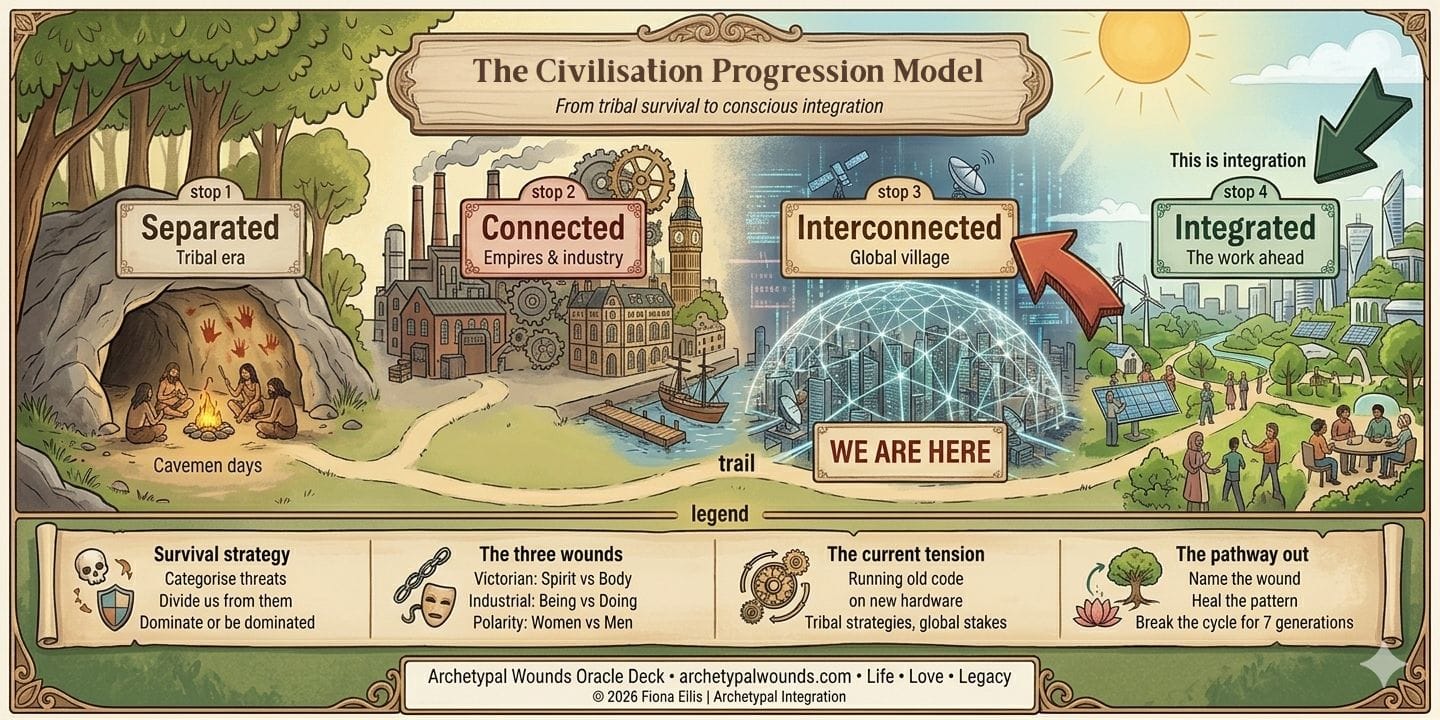
The Civilisation Progression Model
Separated → Connected → Interconnected → Integrated
The old world order worked then. But it will destroy us now — unless we consciously choose to upgrade the code we're running. That's not politics. That's not ideology. That's integration.
And it starts with seeing the pattern clearly enough to name it.
The Science Behind the Pattern
This isn't metaphor. Epigenetic research shows that trauma is transmitted through at least seven generations — encoded in our biology, shaping how we respond to stress, intimacy, and power. The anxiety your grandmother felt during wartime didn't die with her. It became a signal in your nervous system. The shame your grandfather carried about providing for his family didn't stay in the past. It showed up in your relationship with money, rest, and self-worth.
Sovereign Reframe
"You may believe you are failing personally when in truth you are carrying inherited cultural coding."
Sixty-Eight Archetypes. Sixty-Eight Names.
From these three core wounds arise the archetypes you're about to meet in this blog series.
The Suppressed Siren who learned that her power was dangerous. The Failed Provider who measures his worth by what he earns. The Exiled Oracle who was punished for seeing too clearly. The Silent King who abdicated his voice to keep the peace. The Unclaimed Queen who runs everything and is chosen by no one. The Shamed Man whose masculinity was made into a weapon of shame.
These are not roles we chose. They are collective survival patterns encoded across generations. They show up in anxiety, depression, burnout, intimacy struggles, over-functioning, under-earning, people-pleasing, and the quiet desperation of having "everything" while something essential is still missing.
Over the coming weeks, this series will name all sixty-eight Archetypal Wounds — one by one. Each post will show you where the wound came from, what shadow belief it installed, and what the sovereign reframe looks like when that wound is integrated rather than suppressed.
Because shame needs shadows. Healing needs witness.
And you cannot heal what you cannot name.
Can't Wait for the Full Series?
The Archetypal Wounds Oracle Deck gives you all 68 cards in your hands right now — each one with the wound origin, shadow belief, sovereign reframe, and four integration tools: EFT tapping, ACT acceptance processes, guided journaling, and mirror rituals.
The companion online course walks you through each wound with full healing scripts, so you can begin the work of integration today — not in weeks, not in months, now.
Because every person who heals a wound breaks the cycle for seven generations forward.
▶ Shop the Archetypal Wounds Oracle Deck
Fiona Ellis is the founder of Archetypal Integration and creator of the Archetypal Wounds Oracle Deck — a 68-card system mapping the inherited wounds of the Victorian, Industrial, and Feminism/Polarity Collapse eras. She is a Master Trainer of Shamanic NLP and the developer of the Archetypal Integration Method™ (AIM).
Life • Love • Legacy
If any of this work resonates and helps you at all, please feel free to donate to my diesel (and possibly future legal defence) fund: ko-fi.com/fionaellis
Research Disclaimer: This article draws on evolutionary biology, cultural history, epigenetic research, and archetypal psychology. It is intended for education and self-reflection, not as a substitute for professional mental health support. The Archetypal Wounds Oracle Deck was created by Fiona Ellis and informed by AI-assisted research. If you are experiencing a mental health crisis, please contact a qualified professional.
© 2026 Fiona Ellis | archetypalintegration.com
Life · Love · Legacy
Bridging spirituality, science, and psychology for those ready to understand what's been running beneath the surface — and choose differently.
The Archetypal Integration Method™ (AIM) is a proprietary framework developed by Fiona Ellis that bridges archetypal psychology, cultural trauma theory, and Shamanic NLP to address inherited patterns passed through up to seven generations.
© 2026 Fiona Ellis | archetypalintegration.com | Perth, Western Australia
archetypalintegrationmethod@gmail.com
The content on this website is for educational and informational purposes only and is not a substitute for professional medical, psychological, or therapeutic advice, diagnosis, or treatment. Fiona Ellis is not a licensed psychologist, psychiatrist, or medical practitioner. The Archetypal Integration Method is a coaching and personal development framework. Always seek the advice of a qualified health provider with any questions regarding a mental or physical health condition. Use of this website, its content, courses, and associated materials is at your own discretion and risk.
All Rights Reserved.